 |
| Bill Fritz with used running shoes donation for charity from his runners. |
When Bill Fritz and Oscar Moore arrived
at Glassboro State College (NJ) together in 1971 from Southern Illinois
University not even the most knowledgeable track aficionado could have predicted
that they would be one of the most successful track and cross-country coaching
duos in NCAA Track and Field and Cross Country history.
The relationship was unique. Fritz was
to assist 1964 Olympian Moore as they started the first track and field team at
Glassboro. Their roles were reversed for the already established Glassboro
State cross-country team with Fritz the head coach and Moore the assistant. The
Glassboro “Professors” cross-country team they inherited was an all-male squad
in an overwhelmingly female school known as a “teaching college”.
 |
| Bill Fritz and Oscar Moore |
The team ran through the peach and apple
orchards surrounding Glassboro.
Like many wildly successful partnerships,
Fritz and Moore’s start was inauspicious as the first words from the Glassboro
Athletic Director Fritz and Moore were to “get a haircut”.
“We just ignored him,” remembers Moore
with a laugh over 40 years later. “Fritz is a Native American and had beautiful
long flowing hair, and I had an afro.”
Despite
ignoring their first bit of South Jersey “advice”, the coaching duo would continue
to coach together until Moore’s retirement in 2003.
Together they coached 130 All-Americans and 24 NCAA individual
champions in track for men and women, dozens of All Americans in Cross
Country, as well as 44 Division III National Champions, five straight Division
III National Championships, dozens NJ
Conference Championships and a name change to Rowan University.
Fritz continued coaching until his
retirement this summer. Coaches Fritz and Moore were reunited with a large
number of their runners at a Rowan University bar b que honoring Fritz for his
42 years of coaching at Rowan. As their former runners shared laughs and
reminisced over great times with Coaches Moore and Fritz some mentioned
probably their greatest legacy—the number of their runners who went on to
successful coaching careers, most in New Jersey. A quick tally produced over
two dozen coaches, men and women who ran for Fritz and Moore.
One of the former coaches is Ken Kling,
Bill Fritz’s first runner at Glassboro State College. Kling remembered:
” The coach before Fritz and Oscar Moore
was a guy who was in the Physical Education Department, a Gymnastics Coach who
took Cross Country on a whim. Although we had winning teams, he did not know
what he was doing. He would ask other coaches he met what they did for
workouts. If the coach said hills, we would do hills for the week... If it was intervals,
we did intervals for the week. You get the idea. I had to tell him how to set
up workouts and what type of workouts to do. I even gave him a copy of Tom
Osler’s book “The Conditioning of Distance Runners”. There was no structured
program.
Before the end of my junior year, we
were told that the School was hiring two new coaches from Southern Illinois
University, Bill Fritz for Cross Country and Oscar Moore for the first ever
track team that was to start the following spring. The bio on the two was very
impressive. We knew about Oscar, as he was a well -known Olympic runner.
When we were introduced to Bill Fritz,
here was a young guy in his thirties with a goatee, mustache, glasses, big
physique but slim, who looked very distinguished. He had an easygoing style and
was quick with a laugh. Fritz was a very likeable person from the start.
Talking to him it was clear about his knowledge and love of the sport as it
radiated from his demeanor.
When Fritz and Oscar came onto the coaching
scene, they brought a detailed step-by-step program that included long
distance, intervals and hills that was challenging and pointed toward the big
meets. He contacted us over the summer and wanted us to do at least 500 miles
during the summer.
Before the meets he would say, “I want
you to warm up so you are glistening before the race.” When he would explain
about a hill workout he would say, “I want you to work the hills real hard and
I want you to remember that the hills are your friends” When we would do
intervals, it was all scientific. Sometimes he would time our rest period and
sometimes we had to take a pulse count until our pulse was back to normal
resting rate. For instance we would run
20 x400’s and each time after that he would reduce the time and reduce the rest
period. After tough workouts, he would say, “Yeah, you are going to be tough to
deal with!”
 |
| Bill Fritz surrounded by some of his runners |
With his varied workouts, he made it fun
and challenging. We only had eleven on the team. Our record was something like
9-5 and we took second in the District championships, which qualified us for
nationals. We did not get to go to nationals as the Athletic Director, said
even though we qualified there had to be a written policy in place on the criteria
to go to nationals.
Oscar would run with us each day which
was an inspiration to the team, as he was so smooth and fluid and he moved
effortlessly. He would give us tips for warming up for races, race strategy,
weekend workouts, rest and diet.
 |
| Fritz with runners Heath and McArthur |
Although I only had the opportunity and
the privilege to run for Coach Fritz for one year, it was one of my most
enjoyable cross-country years ever. My only regret was that I did not have more
years to work under his guidance.”
When asked how long he had been coaching
at Rowan Fritz would often answer with his trademark good humor, “Well, let’s see, it’s been six
decades, two centuries and two millenniums.”
Fritz downplayed his many National Coach
of the Year awards: “I don’t even worry about those [individual accomplishments]
because most of those are political anyway,” he says. “Track is all settled out
on the field, it’s all in feet and inches. There’s no voting, it just comes out
the way it comes out.”
I consider myself extremely lucky to
have Browning Ross as my high school coach (Gloucester Catholic), and Fritz and Moore as my college
coaches at Rowan/Glassboro. All 3 were great coaches but even greater men.
 |
| Fritz with runner Sid Holzer |
At his retirement Bar-b-que, I asked Fritz if there
is anything about coaching that he would not
miss. He quickly answered, “The time between competition. After a while you do get tired of the time
spent away from home waiting for the competition to start, and also the time
between events.”
I
quickly had a flashback to the long track meets when I ran for Glassboro State spent in Long Island, New York waiting for the 10k race walk, 400-meter relay
and other events to finish so I could run my event the Steeplechase, and then
sitting through another 4-5 hours of events before we could leave. My mind
boggled at the thought of doing that and the required travel for over 40 years.
At the Bar-B-Que, Coach Moore
had a confession to make to his gathered runners, “All of those times I ran
with you guys in cross country I was spying. I would go back to Fritz and say
“So and so can run a lot faster, he just kept up with me for 8 miles,(Moore was
the top ranked Masters runner in the country at the time), I don’t think he is
pushing enough in the races. Fritz would have that inside information and
tailor his workouts and use it to try to positively motivate that runner.”
 Fritz was always positive. His most common words of encouragement were
“Good effort!” He was also quick with a laugh or a joke to break the tension
for the entire four years that I ran for him.
 |
| Oscar Moore, Pete McArthur, Bill Fritz, Jack Heath |
I was pleasantly surprised that one of
Fritz’s favorite memories was from the years when I ran on the team. The
Glassboro State Track bus would pick me up on Route 42 a block from my house,
on the way to meets in New York City and Philadelphia and other destinations.
One time while waiting for the bus, a New Jersey State Trooper stopped and
asked me where I was headed in my Glassboro tracksuit. When I said “Kings Point,
Long Island he offered to relay me most of the way up to New York via NJ state
troopers barracks. I told him the bus would be taking me up in a few minutes.
Ironically, the team bus came flying by me at 60 miles an hour. I waited and it
circled back and picked me up in a few minutes. In 42 years of coaching, Bill
Fritz never forgot anyone.
My Glassboro track and cross country teammate
Pete McArthur summed up the experience of running for Coach Bill Fritz and our
universal respect in these words. “I have a son who is going into college next
year and hopes to play sports, I couldn’t think of a better thing to have
happen to him than to have a coach as fine and caring as Bill Fritz and Oscar
Moore were to us.”
Best of luck to Justin Dimit, named as Bill Fritz's replacement as Mens Track and Cross-Country Coach at Rowan. Dimit and Women's Coach Ringo Adamson will look to continue the long tradition of excellence set by Bill Fritz and Oscar Moore.
 |
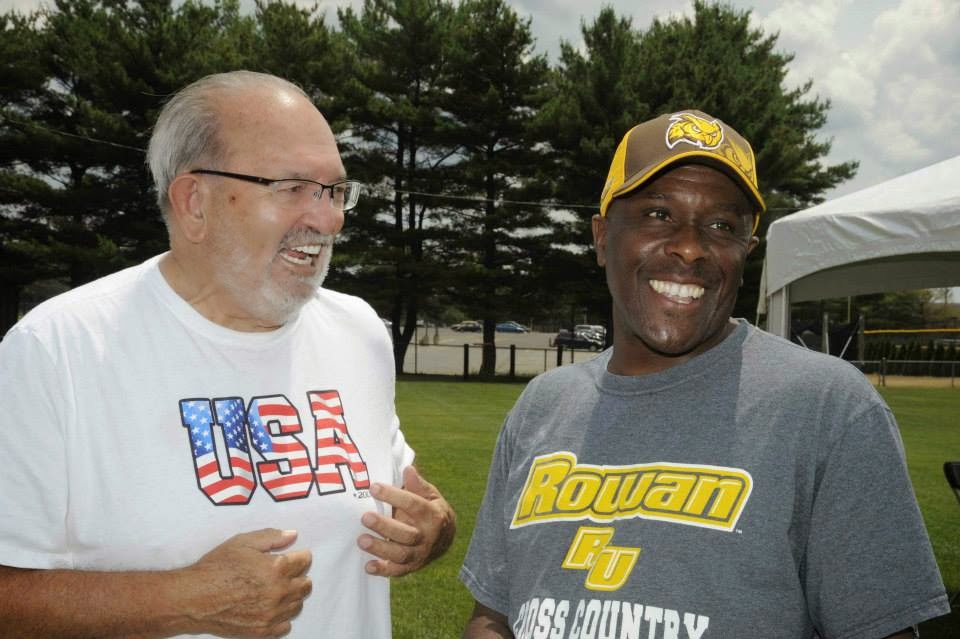
| Fritz with many of his former runners dating back to the early 70's |
 |
| Bill Fritz and Rowan Women's Track and Cross Country Coach Ringo Adamson |
 |
| Tom Osler and Bill Fritz |
 |
| Retirement cake signed by Fritzs' runners |
 |
| Coach Fritz with Lady Prof Runners |
 |
| Tom and Kathy Osler with Bill Fritz |

 Increased speed

 The best strength training programs
for runners focus on heavy lower body lifting and include movements like
squats, deadlifts, step ups and lunges. Runners who are new to strength
training should focus on building baseline strength and flexibility first and
vary the tempo as strength improves.

 The best strength training programs
for runners focus on heavy lower body lifting and include movements like
squats, deadlifts, step ups and lunges. Runners who are new to strength
training should focus on building baseline strength and flexibility first and
vary the tempo as strength improves.


