Sunday, September 21, 2014

The Best Warm Up Ever


By Lauren Bertolaccilauren bertolacci


Here is a warm-up video that incorporates all of the dynamic stretches that the Gloucester Catholic Cross Country Team does, and a description of each of the warm up components from Lauren Bertolacci.
http://vimeo.com/13390804
"Warm-ups are so important for your session, and this one is a beauty.
It gets you going, gets you mobile, explosive and feeling ready for anything.
As I mentioned the whole thing is great, there are lots of things you can add and take away to suit you best, however this kind of warm up is good for keeping you mobile. It can even work as a separate session. remember to do everything twice, and to jog back in between.
Here are the components of the warm up in order and some teaching points.

Jog- Simple, jog up and down twice.
Knee to Chest- Walk, pull your knee to your chest and come up on your toes

Butt Sits- Ankle to knee, and sit down, hold it for one second. Concentrate on actually sitting.Hamstring Walk- Simple dynamic stretch for your hamstring
Quad Walk- Simple dynamic stretch for your quads, try and jerk slightly at the end like I do to get that stretch.
Side Step- Just to keep things moving, although the jog back should do that just fine.
Lunge to instep- Take your elbow to your instep, great stretch for almost everything.
ITB Walk- Dynamic stretch that targets your ITB and the side of your butt, the foot that is in front is the side that you go. I did one the wrong way!

Dynamic Stretch Courtesy of James Madison University
High kicks-Simple high kicks for your hammies.
Skip with Arm Swings- Just something for your arms.

Hip Overs- Taking your foot over something imaginary, skip in between.

Skips- Pretend there is a bar coming out of your ankle and skip over it, fast.
Lunges- Put your arms in the air to get that fascia stretch.
High Skips- Same as skips but very high, use more power, you’ll be warm by now.
REMEMBERDo everything twice, even though it is done once in video.
Jog back every time, you have to keep moving to warm up properly."
Here is a link to Lauren Bertolacci's fitness website:
For more information on dynamic and static stretching: http://ramscrosscountry.blogspot.com/2008/04/real-stretcher.html


Friday, August 22, 2014

19 Reasons to Run


19 Reasons to Start RunningThe Huffington Post  by Sarah Klein
You can probably come up with countless reasons for why you just can't run. You don't have enough time or enough energy or the right neighborhood or the right sports bra. You don't have the body or sturdy enough joints or the desire to compete in a race. You're just not crazy enough to be a runner.
To all of those reasons and more, we say: How do you know until you've tried?

The beauty of running is that just about everyone can play -- and succeed -- in a sport that has the power to change lives.
1. Because you can do it anywhere. We think it's safe to say that the more accessible your fitness routine is, the more you'll stick with it. Traveling for work? You can still go for a run! On vacation? You can still go for a run! Snow, sleet, rain, hail? Yep, you can still go for a run.
2. To make new friends. You don't have to toe the starting line to meet some friendly competition. Try a group run organized by a local running club or running store, or look for a Meetup group of like-minded runners near you.
3. To spend some time alone. Then again, if the running buddy thing isn't your scene, you might as well lace up for some "me time" and escape everything for a while.
4. To accomplish a goal. We don't have to tell you that it feels darn good to set a goal and then crush it. If you've always wanted to run -- whether your goal is to finish a marathon or just a loop around the block -- now's the time to lace up and check it off the list.

5. Because you might live longer. While more isn't always better, there's solid evidence that a moderate running routine will add years to your life, even if you're only logging a few minutes each day.
6. To burn calories. While we don't recommend exercising for the sole purpose of losing weight -- there are just so many other benefits! -- there's no denying that running is a big calorie burner. Your individual burn will vary depending on your sex, weight, level of activity and how far and fast you run, but you can expect to burn about 50 percent more calories per mile than you would walking the same distance.
7. For the smiles. A whole host of feel-good chemicals are released in the brain when we exercise that essentially act like drugs. It's called the Runner's High for a reason!
8. To remember. Learning a new language isn't the only way to keep an aging brain sharp. Research suggests that staying physically active is even more important in preventing cognitive decline.
9. Because you'll sleep better. Regular exercisers reported significantly better shut-eye than couch potatoes in a 2013 survey from the National Sleep Foundation. But the survey's most promising finding was that a little bit goes a long way: Adding just 10 minutes of physical activity helped non-exercisers report better sleep.
10. To feel more energized. You might think that a run would drain you after a long day, but physical activity actually serves to reenergize, perhaps even better than a quick nap.


11. For your heart. The American Heart Association recommends 40 minutes of moderate to vigorous aerobic activity -- a.k.a. running -- three or four times a week to help lower blood pressure and cholesterol naturally.
12. To relax. Those same feel-good chemicals released in the brain that lift your spirits can also help alleviate stress, even though exercise is technically a stressor on the body.

13. Because you might reduce your cancer risk. According to the National Cancer Institute, there is strong evidence that physically active people have lower risks of colon and breast cancer. Emerging research suggests exercise confers some protection against endometrial, lung and prostate cancers, too.
14. Because you'll get to spend more time outside. And a little extra time in nature in turn can keep you calm, happy and energized.
15. To see more of new places. There's nothing wrong with a casual stroll through your new neighborhood or the city you're vacationing in, but you could see a whole lot more at a faster pace!

16. Because you'll (probably) get to buy new shoes. If you haven't run in a while (or ever before), you'll probably need some new sneaks. They're about the only essential gear for running -- aside from the right sports bra for the ladies -- and who doesn't love shoe shopping?
17. To protect your bones. Weight-bearing exercise like running is key to building strong and healthy bones and slowing bone loss. (And no, running won't cause arthritis.)
18. To stay sniffle-free. You just might breeze through cold and flu season thanks to your new running routine. Moderate amounts of exercise seem to bolster the immune system's ability to ward off viruses. 
19. To make a difference. When you're ready, try a race for charity. When the training miles get tough, remember the cause you signed up to run for -- and the people your running can benefit.


Thursday, July 24, 2014

The Lydiard Way to Run Hills


Arthur Lydiard, the famed New Zealand runner and coach ( 6 July 1917-11 December 2004) is probably the most influential long distance running coach in history. 
His sane training methods produced Olympic champions such as Peter Snell, Murray Halberg, Barry Magee, and John Walker. His training methods have stood the test of time, and have influenced many of the top running coaches today.

Arthur Lydiard
Here is a video of Lydiard describing his hill bounding training phase with his commentary.
https://www.youtube.com/watch?v=7Fn2Kyf_DyQ
 

 Below is Lydiard's description of the importance of hill training to develop a runners speed and start to develop the anaerobic capacity to exercise at a high level.
"It is necessary to bring resistance to the leg muscles to develop the muscle fibers; in particular, the white (fast twitch) muscle fibers that are mainly responsible for giving better speed.
I have found that a form of osotonic exercise will develop white muscle fibers better than isometric
exercise and that quite quickly the speed can be developed. By springing up-hill, with a series of short and sharp resistance, you can use your body's weight as resistance for your leg muscles.

The up-hill springing will also stretch the muscles and tendons to the extreme experienced during
competitions and other training and assist in added flexibility and speed. It will also help to eliminate the possibility of pulled muscles and strained tendons later.

Ankle flexibility
is of great concern to the runner: and with strong and flexible ankles, the runner is able to increase stride length.
A good running technique is also important: and by learning to run with the hips comfortably forward,the runner is able to bring the knees up higher. This in turn allows the feet to follow through higher, in so shortening the lever and allowing for a faster leg action.

So it is important to develop leg power, flexibility, and a good economical running style. With good
speed development, the runner can run at relatively the same speed more economically. This is of great importance to the marathon runner as well as the track runner.
By using hill training, it is possible to develop all these abilities during the same training sessions so
saving valuable time.

The training that I suggest in the following paragraph is not easy to do and can be quite testing. A runner needs to be well conditioned to be able to do a 1 hr workout properly, A runner should also understand what he is trying to achieve by using the exercise, so as to apply it according to his/her fitness and capacity to train with respect to development and age.
Find a hill with a raise of near one in three, or a little steeper: on grass, forest trail, or the road that will give good traction so that it is possible to spring up-hill without slipping. It should be about 200 to 300 meters long or longer, with a flattish area at the base of approximately 200 to 400 meters where you can sprint, and an area at the top where it is possible to jog.
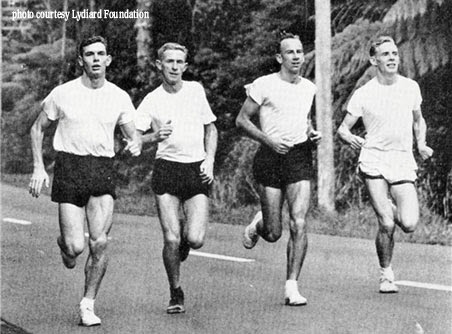
Lydiard's Boys (left to right) Peter Snell, Murray Halberg, Barry Magee and Alan McKight training on the 22-mile Waiatarua Loop in New Zealand.
If a circuit can be found with a steeper hill and a similar flattish area at the top as mentioned, that would bring you into a more gradual down-hill, leading to the flat at the bottom: it is better for the down –hill running and seems less tiresome psychologically.

    Approach the training this way: Warm-up for at least 15 minutes. This being sufficient; discard unnecessary clothes at the base of the hill so as to allow the maximum freedom of movement.

Then start springing up the hill with a bouncing action and slower forward progression.
It is necessary to use the body's weight for resistance; and the slower the forward momentum is, the more resistance will be felt. The Center of Gravity must be lifted up and down to gain resistance, not just lifting the knees.

Keep the upper body relaxed with the arms loose at the sides. Hold the head up; and do not look down at the ground which tends to throw the hips back. Keep your knees coming up high with the hips held comfortably forward. Do all that you can or feel capable of doing.

Should the exercise be too tiring to go all the way up the hill, then jog some yards before doing more.
Use it according to your needs and ability.

At the hill top, jog easily for near three minutes before running down-hill with a fast relaxed striding
action, this will develop the fine leg-speed and also stretch leg muscles for better stride length. Should the hill that you have selected be too steep for this exercise, then it is better to take it easily as you run down. Jog some yards before doing more.

The down-hill section should be such that it allows the runner to stride down fast without fear of losing control and falling.

At the base of the hill, some windsprints (sprint repetitions) should be done to gradually accustom your body to exercise anaerobically, varying the distances from 50 to 400 Meters with each circuit, If the circuit is short, do the windsprints only every 15 minutes.
 It is not advisable to suddenly go into a great volume of intense anaerobic training as very many people do. So it is logical that this anaerobic training should initially be not to intense, and in a reasonable volume.
By only doing windsprints on the short stretch at the bottom of the hill, and by only doing them every 15 minutes, it is not possible to do to much. Use whatever distance you like, but for best results, you try to use 50, 100, 200, and 400 windsprints.

Snell easily wins 1500 Olympic final in Tokoyo

Go through the circuit again, etc, until you have been out for an hour, or according to your ability to exercise this way. Then cool down for at least 15 minutes.

This training should be done three days weekly with the alternate days for leg-speed running, three a week. On the other day of the week a long run of 1.5 to 2 hours should be completed at an easy effort."
Note: Lydiard placed the hill phase of his training between the long distance and speed phases of  his training plan.

Lydiard's description of hill bounding has many similarities with the "100 up" described on this site http://ramscrosscountry.blogspot.com/2014/06/the-one-exercise-that-might-changeyour.html


Thursday, July 17, 2014

These "Kids" Love To Run

When I heard about 44 kids that love to run in Maine, the running you tube video stars, we had to visit them on a recent trip to Maine.

The enthusiastic runners were both boys and girls, and they had a perfect place to train on Sunflower Farm and Creamery in Cumberland Maine. These runners, along with the farms owner Hope Hall were all glad to see us. The runners, of course were baby Nigerian dwarf goats.
Hope had run cross country in high school,  and she said she was hoping a cross country coach would see the video and stop by the farm.
 The 44 little cross country runners who ran daily with Hope and her two daughters were all destined to be sold, in pairs as pets and would soon be leaving the farm behind.
    The baby goats were all extremely friendly and social. While holding one baby, Maggie who put her head on my shoulder, others lined up to be picked up. They gently touched my leg with their paws to get my attention as if saying "I'm next."
The babies also gathered my their mothers when they weren't being picked up. Hope, "Besides being friendly and great with little children, they are also intelligent-- they look direct into your eyes."
Hope who knows all the kids and parents by name also said, "I really believe most people and animals were naturally born to run. When you watch the baby goats run you can see the essence of running and what an enjoyable, natural activity it is."
Long may they run in their new homes!


Here is a link to the farm and their great creamery: http://www.sunflowerfarm.info/


Wednesday, June 18, 2014

The One Exercise That Might ChangeYour Running-- The 100 Up


The One Exercise That Just Might Change Your Running Forever
The Huffington Post  | By Sarah Klein
 on Dahlen, The Huffington Post
What if all it took to improve your running immeasurably was a few minutes marching in place?
In a 2011 New York Times Magazine feature, Christopher McDougall, author of Born to Run: A Hidden Tribe, Super Athletes and the Greatest Race the World Has Never Seen experimented with just that."
     I was leafing through the back of an out-of-print book, a collection of runners' biographies called 'The Five Kings of Distance,' when I came across a three-page essay from 1908 titled 'W. G. George's Own Account From the 100-Up Exercise,'" he writes. "According to legend, this single drill turned a 16 year old with almost no running experience into the foremost racer of his day."
Walter Goodall George's earliest sporting interests were rugby and cycling, but he went on to win over 1,000 amateur prizes and races and set long-standing records as a professional runner. "He became unbeatable over the middle distances in an era before training became scientific," the Oxford Dictionary Of National Biography writes, all while pioneering his own personal brand of "scientific" training, namely the 100-Up. In 1878, at age 19, he wrote a plan to break the then-world record for the mile -- and proceeded to run nearly exactly his plan's predicted time in 1886. In addition to his 100-Up essay cited by McDougall, he also published a short book on the exercise in 1913, according to the Oxford DNB.
Walter Goodall George in circa 1884. Credit: Getty Images
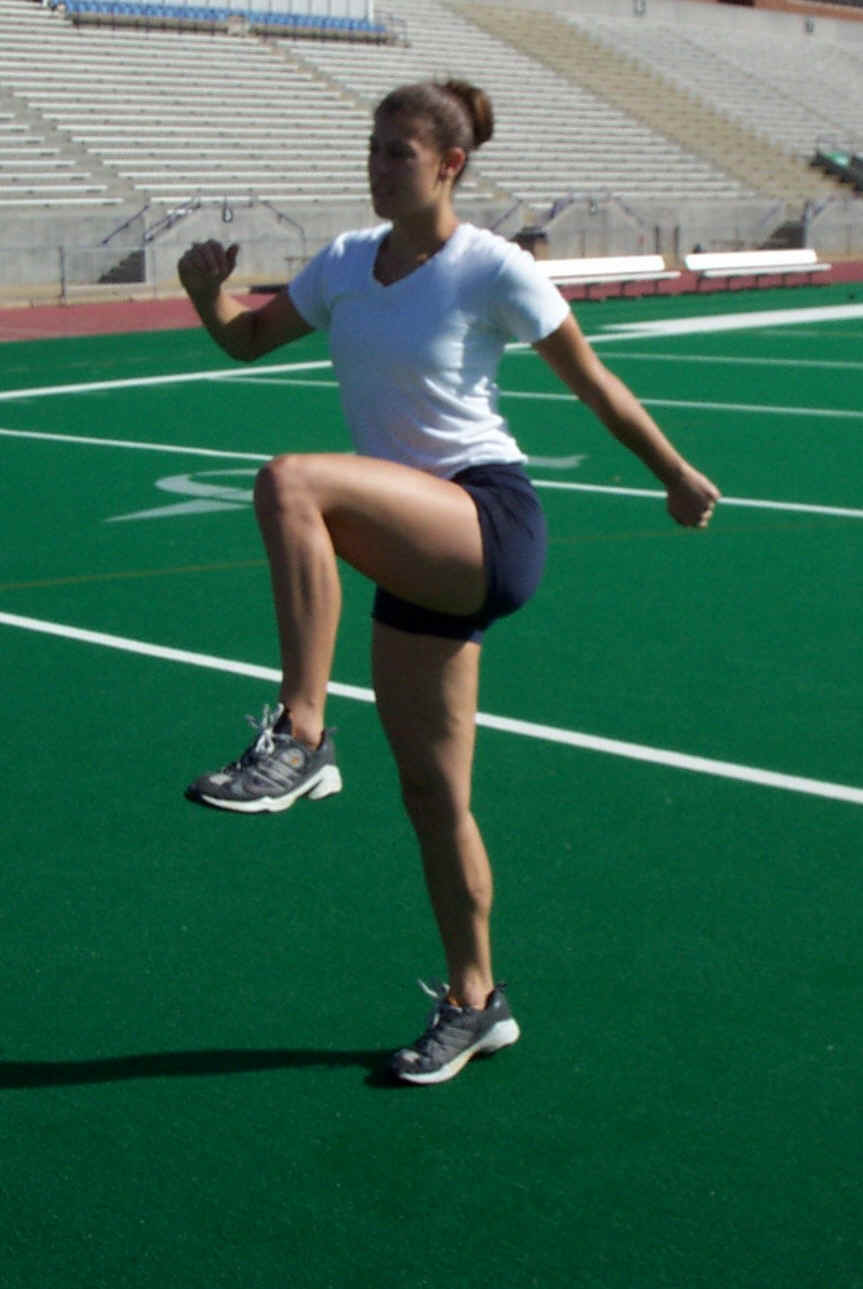
George's 100-Up routine is divided into two parts, the minor and the major. The minor involves standing with both feet about eight inches apart "and your arms cocked in running position," McDougall writes.

Then, raise one knee at a time to hip height, bringing it back down lightly to its original position.
All that's left after that is to repeat this movement 100 times.
 
The major involves the same movement at a higher speed. McDougall quotes George: "The body must be balanced on the ball of the foot, the heels being clear of the ground and the head and body being tilted very slightly forward.... Now, spring from the toe, bringing the knee to the level of the hip.... Repeat with the other leg and continue raising and lowering the legs alternately. This action is exactly that of running.”
Sounds a little too simple, no?
Experienced runners will likely recognize these movements as the tried-and-true running drill commonly referred to as high knees, a simple way to up strength and endurance of the hip flexor and quad, according to New York Road Runners (NYRR). Straightforward as it looks, high knees --and other running drills -- can help you become a better runner, says NYRR coach John Honercamp. The 100-Up is essentially exaggerated running form, and performing 100 repetitions can help build muscle memory during a similar state of fatigue that a runner might experience at the end of a tough workout or a grueling race, he says.
But it's the focus on form that's most important. "You're reinforcing poor form if you're doing it improperly," says Honerkamp. "Once you stop doing it correctly, you shouldn't do it at all." That means concentrating not just on returning each foot to its starting point, but paying attention to arm swing, keeping the core stable and landing close to your center of gravity on the balls of your feet every single time, he says. For most 100-Up beginners, 100 reps is a long-term goal. Aim to start with maybe 20 repetitions instead -- or however many you can complete with perfect form.
Don't expect to see immediate results, either, Honerkamp warns. Running on your toes, typically considered more efficient because you're spending less time on the ground, may be the end goal, but heel strikers need to ease into adaptations. "I worry about people trying to drastically change,” says Honerkamp. "It's something to work on and think about, but don't over-think or overcorrect," he says.
Whether or not you devote yourself to the 100-Up for life or simply dabble in running form drills periodically, incorporating focus on form into a warmup or regular training routine is a good idea, says Honerkamp. “People skip [warmups] because they're busy getting out of the door," he says, "but five minutes probably will go a long way."
Note from Runner, Running Author and Rowan Mathematics Professor Tom Osler, "This is wonderful.  For years I wondered what this "100 up" of Walter George was.
Decades ago Dave Costill, the doc who studied runners at Ball State told me about reading George's book and his insistence that he owed his success to the 100 up. 
So now I know what it is. I'm going to give it a try. Starting very, very gently at first."
Article reprinted by kind permission of the Huffington Post and Sarah Klein.