Thursday, October 30, 2014

Ryan Blume Blind Cross Country Runner Overcomes Obstacles, Leads His Summit High School Cross Country Team

By Jim Lambert,  New Jersey Star Ledger

They are two runners on a late-afternoon workout, and side-by-side they gobble up long stretches of leaf-covered sidewalks and tree-lined streets as they weave their way through a busy North Jersey community. As the miles pass and they settle into the run, they are lulled by a setting sun and rhythmic breathing patterns until …
“Step up!”
“Tree on the left!”
“Branch!”
“Step down!”

When Ryan Blume trains with his Summit High School cross-country teammates, Leland Jones is usually right by his side -- letting him know what’s coming. They have been buddies since the fourth grade, and Jones -- favored to repeat as Union County champion on Friday -- looks out for his friend because Blume, 17, is legally blind.
On every run, he is one step from danger and serious injury.
“I want to make sure Ryan knows something is there,’’ Jones said. "I don’t want him to fall or crash.”
Blume, a senior, was born with oculocutaneous albinism type 1. Like most forms of albinism, it results in lack of pigments in the hair and skin, causing them to appear lighter or white. The condition also affects Blume’s vision, which is 20/200 and 20/400 and uncorrectable.
He can’t see detail. He has no depth perception, limited peripheral vision and extreme sensitivity to light, which is why he always wears a hat and sunglasses outside.

Imagine running blindly. Obstacles come out of nowhere. Cars. Pedestrians. Tree roots. Broken sidewalks. Curbs. Rocks. Street signs. Slippery storm drains. Each step requires untold courage – and faith that, thousands of time each day, the ground will be there to meet your sneaker.
''Like a race-car driver, there’s always that thought in the back of your mind that I can fall or crash,” Blume said. “But that doesn’t stop me.'’
And even though his friend has been there for every step, he’s still amazed by it all.
“Running is hard enough when you can see everything,” Jones said. “I can’t imagine doing it while being legally blind. I don’t think I could do it.”
Coaches and runners around Union County are amazed at what Blume has accomplished.  
But Blume isn’t just doing it. He’s an elite runner.

“He does more than just participate,” Summit coach Neal Sharma said. “He competes at a very high level.”
Based on his times, Blume would be the No. 1 runner on a lot of the state’s cross-country teams. He finished in the top half at last fall’s Meet of Champions. But don’t be fooled. The kid isn’t simply gliding through life with Jones as his guide. Someone can’t be there all the time. That’s why, during his sophomore year, Blume took a bad fall in the final descent at the Shore Coaches Invitational at Holmdel Park.

"I thought it was flat, but really it was tilted and I didn’t realize that,” he said. “I wrenched my back. But I got right back up on the horse and finished.’’
That’s how Blume lives his life -- determined to overcome the odds, not letting his condition get him down or stop him from chasing his dreams. His attitude and passion for running have enabled him to become one of the best runners on a Summit team ranked No. 8 in the state.

''Ryan’s the toughest kid on the team and has never ever once complained or made an excuse,’’ said Sharma, who was Blume’s sixth-grade English teacher. “We wouldn’t be the team we are now without Ryan.’’

Blume embraces who he is, often cracking jokes about himself.
''My condition isn’t a stigma,” he said. “It’s part of me and just something I have to get around. I just do the best I can, run as fast as I can -- and try not to fall.”
He laughs. The sense of humor comes in handy, like a dry pair of socks in a gym bag. There are dozens of what-if stories. Blume almost took a spill on a slick Van Cortlandt Park course in the Bronx at the Manhattan Invitational this month.

''There were sharp turns, big hills, it was a bit wet and I had never run there before,” Blume said. “I stumbled a bit, like I do in lots of races.
He finished 21st that day, third on his team, to help Summit win the C Division race.
While Sharma looks out for Blume, the cross-country community helps, too. Sharma scratched Summit from the Shore Coaches Meet at Holmdel on Oct. 4 partly because of how poor weather could have impacted Blume.

Last year, before the Meet of Champions, Sharma contacted Holmdel Park and asked if there was anything park officials could do to assist Blume on a course where he’d previously fallen. Holmdel Park staff spray-painted roots and other trouble spots, and Blume ran what he called his best race ever, a 16:56 at the Meet of Champions, making him the fifth-fastest Summit runner ever on that 3.1-mile course.
Meet director Jack Martin did the same thing at Warinanco Park for the Union County Conference Championships on Oct. 14. Blume placed fifth to help Summit win the Mountain Division title.
“When I race, I see the jerseys ahead of me,” he said. “It’s like being in a tunnel, where you are focused on the light at the end and you’re trying to get out. It’s a bit of a blur. I’m very grateful, and appreciate all the accommodations.”

So does his mother, Beverley, who still finds the races nerve-wracking.
''It’s terrifying. It all looks flat to him,'' she said. ''It’s scary because he’s going fast down these hills. But he’s very confident, so I am very confident in him. Ryan has always been the kind of kid that puts his mind to something and does it. I don’t think anything could stop him from running.''

Blume has been racing practically since he could walk, with the support of family and friends. He has been embraced by the community and running fraternity, but that wasn’t the case when he lived abroad. Before seventh grade, Blume’s father, Chris, took a job in Hong Kong, and Blume’s whole world changed.

"Ryan never had a problem here, but over there they called him a ghost and they would be afraid to touch him,’’ his mother said. ''Some of the meaner kids would punch him and come up behind him and flick him.”
The experience in Hong Kong changed her son, she said.
“In his college essay, he wrote about how determined he was to be who he is and look the way he looks and never judge people by the way they look,” she said. “If he sees kids getting bullied, he stops it. He volunteers at a soup kitchen on the lower East Side. He feels it’s important to help other people.''

Blume, however, said he wouldn’t take back his time in Hong Kong.

''I had negative experiences and dealt with people who were less accepting than what I was used to, but those experiences influenced me to choose mutual aid over mutual aggression,'' he said.
Summit is a slight favorite to snap No. 13 Westfield’s five-year reign at the Union County Championships. Blume could add to his legacy in that race, but his place in Summit High School lore is already secure.
''We always talk about what legacy each senior will leave behind,’’ Sharma said. “We will always bring up Ryan’s name whenever kids say they can’t do something. We will remind them of what Ryan Blume overcame.''

Next fall, Blume will start on a college legacy when he runs cross-country and track at Vassar in Poughkeepsie, N.Y.

''When I was a little kid, I never thought I’d be an athlete and do a sport, and the idea that I reached this level in high school and the idea I can continue in college is just crazy to me,’’ he said. “I couldn’t imagine my life if I didn’t have running."

“Running has presented the same challenges I’ve always dealt with, just at a faster pace. I guess to a certain extent you can call it blind faith."

Great Video of Ryan: http://www.youtube.com/watch?v=TNEr3hKkbcA

Monday, October 6, 2014

Mike Brannigan Not Slowed by Autism-- Keeps Making Strides


Note: Mike Brannigan has Autism and is one of the top runners in the country, a 4:07 miler,
he recently ran in the Championship race at the Shore Coaches Meet at Holmdel, NJ.

By Liam Boylan-Pett      
Published: December 5, 2013 Running Times
Mike Brannigan NXN Northport HS
Mike Brannigan led his team to NXN with a win at the New York regional.
Nestled in a strip mall in East Northport, N.Y., between a Subway and the Morning Dew Foot Spa, is a pizza joint, Joey’s of Mulberry street. Amidst the tables and chairs and pizzas on display, a framed picture hangs on the wall across from the cash register and next to the Coke machine. In the picture is Mikey Brannigan, a square-jawed athlete with dark hair who is running in a race.
     Brannigan is a loyal customer. He runs cross country for Northport High School just two miles away. The night before every race, Brannigan, a junior, gets his lucky meal from Joey’s: the grilled eggplant.
It has been pretty lucky lately. On Nov. 16, Brannigan took second place at the New York state meet. Two weeks later, he won the Nike Cross Nationals (NXN) New York regional race at Bowdoin Park in Wappinger Falls, N.Y. His winning time of 15:29 for 5,000m was just two seconds off the course record and 11 seconds clear of second place. He led his Northport team to a second-place finish, which was enough to earn the team an invite to the NXN championships in Portland on Dec. 7.
"At the two mile mark Brannigan exploded.." Mile Split
“I am so proud of our team,” says Brannigan. “We've really trained hard, and the experience of traveling out west to such an important race is amazing. We are all stoked.” Northport is the first team from Long Island to ever make NXN, where the top 22 teams in the country compete for a national team title.
Brannigan is a lot like the rest of his teammates. He loves SportsCenter and The Big Bang Theory. His favorite book is Pre: The Story of Steve Prefontaine. He enjoys math and science in school. And he drives his mom crazy with his music choices: classic rock staples Motley Crue, Led Zeppelin, AC/DC, and Aerosmith top his most-played list.
There is one thing different about Brannigan, though: When he was 18 months old, he was diagnosed with autism.
Autism is a developmental disorder that affects the brain’s development, impeding social and communication skills. The Brannigan family knew something was different with Mike when he went from crawling to running at age 1. He didn’t speak until he was 4. He was impulsive, sensitive to touching, and hyperactive as a toddler. He was running so much that therapists had to teach him how to walk with his mother, Edith Brannigan, without running away. It took six months. “We really thought he would never be able to function in the world,” Edith says.
The Brannigan family feared Mike was on track to end up in a group home. He attended the Developmental Disabilities Institute until he was 6 before enrolling in the Northport school district, where he was in the special education program.
When he was 7, Brannigan caught a break when he joined the Rolling Thunder Special Needs Program, a running, walking, and wheelchair racing team serving challenged individuals.
Says Edith: “It was like the hand of God came down from the sky and shifted our life completely. It changed everything. It gave us hope.”
The Brannigans knew Mike could run, but how fast was another thing. At the first Rolling Thunder practice he attended, Mike tore around the track, rolling past seasoned athletes.  It was the first time Steven Cuomo, the head coach, president and founder of Rolling Thunder, saw him running. Cuomo turned to Kevin Brannigan, Mike’s father, and said, “You didn’t tell me he could really run.”  Kevin told Cuomo, “We never exactly thought it was a good thing.”
Brannigan excelled in Rolling Thunder throughout the years, and in more than just running. “The best part of the whole thing is that his academics started to improve,” Edith says.
“Within two years, so fourth and fifth grade, he became very close to age appropriate. And I know even though its not scientifically proven,” she continues, “it’s the running that did it. I saw it with my own eyes.”
Now in high school, Brannigan has a 3.3 GPA and has passed his New York Regents. He is planning to go to college and wants to run for a Division 1 school, as he said in a Facebook message, “against the best in the country.” The way he’s running now, he’s one of the best in the country already. He’ll have a chance to prove that at NXN on Saturday.
“The sport of running is ideal for people with autism,” Cuomo says. “[Kids with autism] have trouble socializing, they can’t look you in the eye. The last time I looked, you don’t have to give a speech when you cross the finish line. Just get there first. Just run, baby. Just go.”
Cuomo, who is described jokingly by Edith Brannigan as “a nut job and a saint,” has coached hundreds of athletes that have come through Rolling Thunder, including his own son, who has autism. He doesn’t mince words. “I’m not the Easter bunny, I’m not Santa Claus, I’m not a magician,” he says. “I’m just their coach, and I treat them like you would anyone else.”
"Brannigan all alone at the final plateau..." Milesplit
 
Cuomo says that an autistic athlete shouldn’t be babied, but given a set of rules. “Give the athletes specific instructions and go from there,” Cuomo says. “If you do it enough times, the kids start to visualize what they’re going to do. They learn visually.”
Brannigan’s success is case in point. He has the body of a runner: strong, chiseled legs, a powerful upper body. A coach tells him to run a pace in a workout; Brannigan will do his best to hit it. It’s routine now.
Cuomo is thrilled with Brannigan’s performances of late. “It’s gonna end with Mikey being on an Olympic team,” he says. “I didn’t say a Paralympics team. I said Olympic team. Then we’re gonna blow the lid off what people think these athletes can and cannot do.”
First, Brannigan hopes to make some noise at NXN. His Northport team could as well.
“We couldn’t be more excited about qualifying for NXN,” says Jason Strom, the coach of Northport. Brannigan is a junior, but the next four runners on the team are all seniors. This could be Northport’s last shot at NXN for a few years.
The boys of Northport know how special this is, and Brannigan knows, too. “I am so proud of our team,” he says. “We've really trained hard. I am so happy that we'll do it together.  We'll always have this experience together.”
Strom treats all his athletes the same, including Brannigan. “From day one,” says Strom, “we’ve tried to treat him like any normal athlete, hold him accountable for everything.”
Brannigan thrives in the atmosphere. He’s often the first one out at practice, the first to get his stretching in, the first to start his warm-up. Tim McGowan, the team’s No. 2 runner, says, “Mikey is incredibly dedicated to this sport. Speaking as one of his training partners, his dedication keeps me on my toes and pushes me as well as my teammates.” The team helps him, too. Brannigan’s mother noted how much they take care of him and are aware of his shyness because of his condition.
It’s a team effort all around. “Our assistant coach, Bob Berkley, taught me to set goals since my freshman year,” Brannigan says. “I write down my goals as I go along and then cross them off, one by one. It keeps me focused.”
The next two things on the goal list are a top 3 individual finish at NXN and helping the team finish in the top 10. Brannigan is also looking ahead to indoor and outdoor track. “Keep an eye on me,” he warns.  “This is my year.”
“No kid with autism has done this,” says Cuomo. There are nine NXN regions around the country, so only 9 boys and 9 girls each year are winners. And Brannigan is one of them.
“Mikey is giving every single parent that has a handicap child hope,” Cuomo says.
At NXN, Strom will give Brannigan a race plan. It will be similar to the one at NXN New York, where he’ll sit in the pack for the first two miles before ratcheting up the effort and kicking it home the last mile. “I think Mike never limits himself,” says Strom. “That’s one of the greatest things about him. He just wants to be in it, and he’s in it all the time.”
 
Video of Mike from NBC: http://www.nbcnews.com/nightly-news/how-running-changed-life-boy-autism-n194051
 
Another article about Mike from Runners World: http://www.runnersworld.com/runners-stories/runner-with-autism-finds-success-on-the-track


Sunday, September 21, 2014

The Best Warm Up Ever


By Lauren Bertolaccilauren bertolacci


Here is a warm-up video that incorporates all of the dynamic stretches that the Gloucester Catholic Cross Country Team does, and a description of each of the warm up components from Lauren Bertolacci.
http://vimeo.com/13390804
"Warm-ups are so important for your session, and this one is a beauty.
It gets you going, gets you mobile, explosive and feeling ready for anything.
As I mentioned the whole thing is great, there are lots of things you can add and take away to suit you best, however this kind of warm up is good for keeping you mobile. It can even work as a separate session. remember to do everything twice, and to jog back in between.
Here are the components of the warm up in order and some teaching points.

Jog- Simple, jog up and down twice.
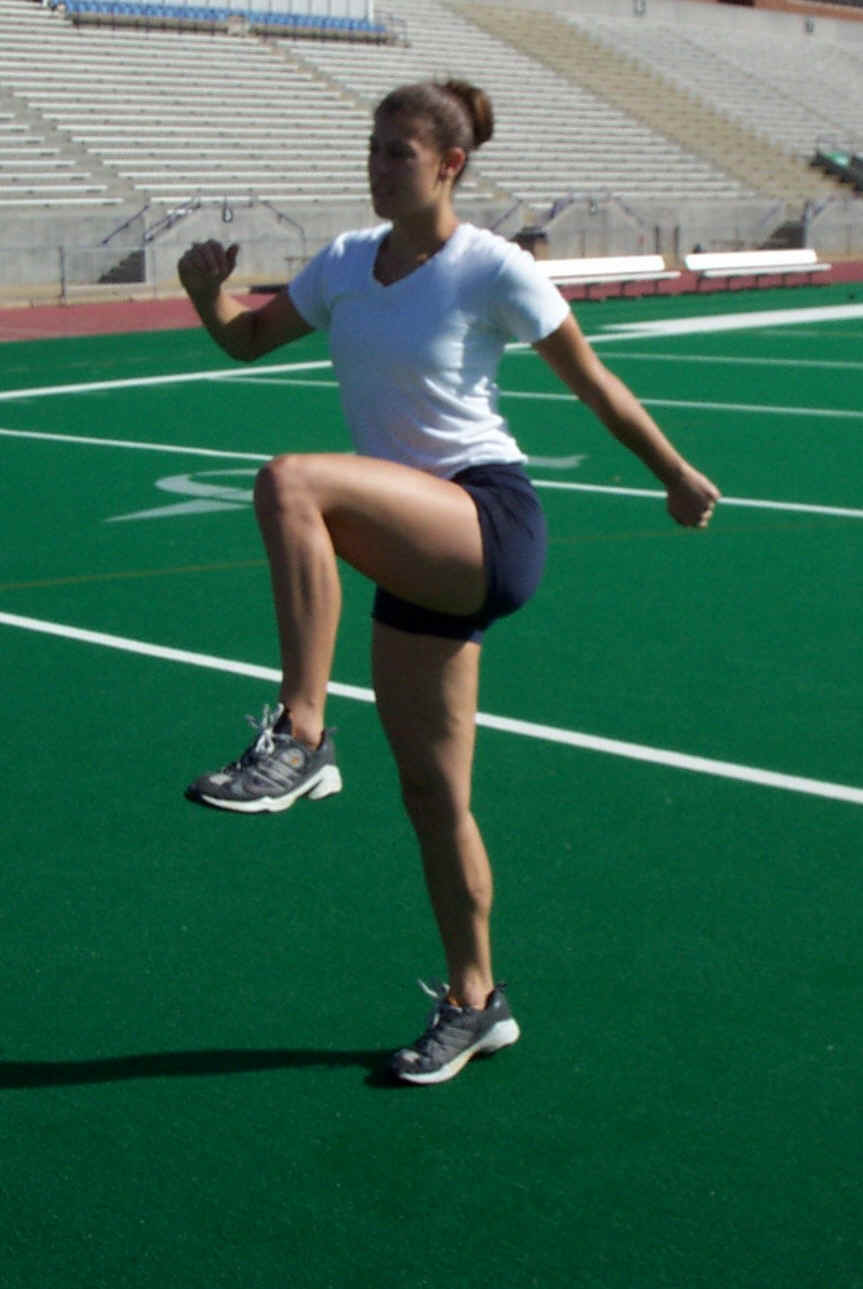
Knee to Chest- Walk, pull your knee to your chest and come up on your toes

Butt Sits- Ankle to knee, and sit down, hold it for one second. Concentrate on actually sitting.Hamstring Walk- Simple dynamic stretch for your hamstring
Quad Walk- Simple dynamic stretch for your quads, try and jerk slightly at the end like I do to get that stretch.
Side Step- Just to keep things moving, although the jog back should do that just fine.
Lunge to instep- Take your elbow to your instep, great stretch for almost everything.
ITB Walk- Dynamic stretch that targets your ITB and the side of your butt, the foot that is in front is the side that you go. I did one the wrong way!

Dynamic Stretch Courtesy of James Madison University
High kicks-Simple high kicks for your hammies.
Skip with Arm Swings- Just something for your arms.

Hip Overs- Taking your foot over something imaginary, skip in between.

Skips- Pretend there is a bar coming out of your ankle and skip over it, fast.
Lunges- Put your arms in the air to get that fascia stretch.
High Skips- Same as skips but very high, use more power, you’ll be warm by now.
REMEMBERDo everything twice, even though it is done once in video.
Jog back every time, you have to keep moving to warm up properly."
Here is a link to Lauren Bertolacci's fitness website:
For more information on dynamic and static stretching: http://ramscrosscountry.blogspot.com/2008/04/real-stretcher.html


Friday, August 22, 2014

19 Reasons to Run


19 Reasons to Start RunningThe Huffington Post  by Sarah Klein
You can probably come up with countless reasons for why you just can't run. You don't have enough time or enough energy or the right neighborhood or the right sports bra. You don't have the body or sturdy enough joints or the desire to compete in a race. You're just not crazy enough to be a runner.
To all of those reasons and more, we say: How do you know until you've tried?

The beauty of running is that just about everyone can play -- and succeed -- in a sport that has the power to change lives.
1. Because you can do it anywhere. We think it's safe to say that the more accessible your fitness routine is, the more you'll stick with it. Traveling for work? You can still go for a run! On vacation? You can still go for a run! Snow, sleet, rain, hail? Yep, you can still go for a run.
2. To make new friends. You don't have to toe the starting line to meet some friendly competition. Try a group run organized by a local running club or running store, or look for a Meetup group of like-minded runners near you.
3. To spend some time alone. Then again, if the running buddy thing isn't your scene, you might as well lace up for some "me time" and escape everything for a while.
4. To accomplish a goal. We don't have to tell you that it feels darn good to set a goal and then crush it. If you've always wanted to run -- whether your goal is to finish a marathon or just a loop around the block -- now's the time to lace up and check it off the list.

5. Because you might live longer. While more isn't always better, there's solid evidence that a moderate running routine will add years to your life, even if you're only logging a few minutes each day.
6. To burn calories. While we don't recommend exercising for the sole purpose of losing weight -- there are just so many other benefits! -- there's no denying that running is a big calorie burner. Your individual burn will vary depending on your sex, weight, level of activity and how far and fast you run, but you can expect to burn about 50 percent more calories per mile than you would walking the same distance.
7. For the smiles. A whole host of feel-good chemicals are released in the brain when we exercise that essentially act like drugs. It's called the Runner's High for a reason!
8. To remember. Learning a new language isn't the only way to keep an aging brain sharp. Research suggests that staying physically active is even more important in preventing cognitive decline.
9. Because you'll sleep better. Regular exercisers reported significantly better shut-eye than couch potatoes in a 2013 survey from the National Sleep Foundation. But the survey's most promising finding was that a little bit goes a long way: Adding just 10 minutes of physical activity helped non-exercisers report better sleep.
10. To feel more energized. You might think that a run would drain you after a long day, but physical activity actually serves to reenergize, perhaps even better than a quick nap.


11. For your heart. The American Heart Association recommends 40 minutes of moderate to vigorous aerobic activity -- a.k.a. running -- three or four times a week to help lower blood pressure and cholesterol naturally.
12. To relax. Those same feel-good chemicals released in the brain that lift your spirits can also help alleviate stress, even though exercise is technically a stressor on the body.

13. Because you might reduce your cancer risk. According to the National Cancer Institute, there is strong evidence that physically active people have lower risks of colon and breast cancer. Emerging research suggests exercise confers some protection against endometrial, lung and prostate cancers, too.
14. Because you'll get to spend more time outside. And a little extra time in nature in turn can keep you calm, happy and energized.
15. To see more of new places. There's nothing wrong with a casual stroll through your new neighborhood or the city you're vacationing in, but you could see a whole lot more at a faster pace!

16. Because you'll (probably) get to buy new shoes. If you haven't run in a while (or ever before), you'll probably need some new sneaks. They're about the only essential gear for running -- aside from the right sports bra for the ladies -- and who doesn't love shoe shopping?
17. To protect your bones. Weight-bearing exercise like running is key to building strong and healthy bones and slowing bone loss. (And no, running won't cause arthritis.)
18. To stay sniffle-free. You just might breeze through cold and flu season thanks to your new running routine. Moderate amounts of exercise seem to bolster the immune system's ability to ward off viruses. 
19. To make a difference. When you're ready, try a race for charity. When the training miles get tough, remember the cause you signed up to run for -- and the people your running can benefit.


Thursday, July 24, 2014

The Lydiard Way to Run Hills


Arthur Lydiard, the famed New Zealand runner and coach ( 6 July 1917-11 December 2004) is probably the most influential long distance running coach in history. 
His sane training methods produced Olympic champions such as Peter Snell, Murray Halberg, Barry Magee, and John Walker. His training methods have stood the test of time, and have influenced many of the top running coaches today.

Arthur Lydiard
Here is a video of Lydiard describing his hill bounding training phase with his commentary.
https://www.youtube.com/watch?v=7Fn2Kyf_DyQ
 

 Below is Lydiard's description of the importance of hill training to develop a runners speed and start to develop the anaerobic capacity to exercise at a high level.
"It is necessary to bring resistance to the leg muscles to develop the muscle fibers; in particular, the white (fast twitch) muscle fibers that are mainly responsible for giving better speed.
I have found that a form of osotonic exercise will develop white muscle fibers better than isometric
exercise and that quite quickly the speed can be developed. By springing up-hill, with a series of short and sharp resistance, you can use your body's weight as resistance for your leg muscles.

The up-hill springing will also stretch the muscles and tendons to the extreme experienced during
competitions and other training and assist in added flexibility and speed. It will also help to eliminate the possibility of pulled muscles and strained tendons later.

Ankle flexibility
is of great concern to the runner: and with strong and flexible ankles, the runner is able to increase stride length.
A good running technique is also important: and by learning to run with the hips comfortably forward,the runner is able to bring the knees up higher. This in turn allows the feet to follow through higher, in so shortening the lever and allowing for a faster leg action.

So it is important to develop leg power, flexibility, and a good economical running style. With good
speed development, the runner can run at relatively the same speed more economically. This is of great importance to the marathon runner as well as the track runner.
By using hill training, it is possible to develop all these abilities during the same training sessions so
saving valuable time.

The training that I suggest in the following paragraph is not easy to do and can be quite testing. A runner needs to be well conditioned to be able to do a 1 hr workout properly, A runner should also understand what he is trying to achieve by using the exercise, so as to apply it according to his/her fitness and capacity to train with respect to development and age.
Find a hill with a raise of near one in three, or a little steeper: on grass, forest trail, or the road that will give good traction so that it is possible to spring up-hill without slipping. It should be about 200 to 300 meters long or longer, with a flattish area at the base of approximately 200 to 400 meters where you can sprint, and an area at the top where it is possible to jog.
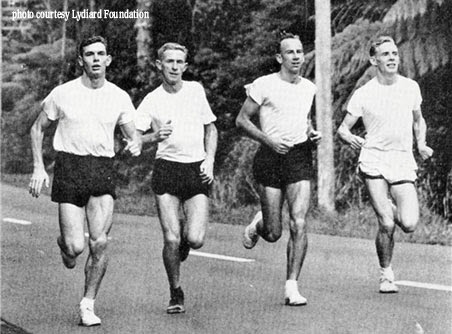
Lydiard's Boys (left to right) Peter Snell, Murray Halberg, Barry Magee and Alan McKight training on the 22-mile Waiatarua Loop in New Zealand.
If a circuit can be found with a steeper hill and a similar flattish area at the top as mentioned, that would bring you into a more gradual down-hill, leading to the flat at the bottom: it is better for the down –hill running and seems less tiresome psychologically.

    Approach the training this way: Warm-up for at least 15 minutes. This being sufficient; discard unnecessary clothes at the base of the hill so as to allow the maximum freedom of movement.

Then start springing up the hill with a bouncing action and slower forward progression.
It is necessary to use the body's weight for resistance; and the slower the forward momentum is, the more resistance will be felt. The Center of Gravity must be lifted up and down to gain resistance, not just lifting the knees.

Keep the upper body relaxed with the arms loose at the sides. Hold the head up; and do not look down at the ground which tends to throw the hips back. Keep your knees coming up high with the hips held comfortably forward. Do all that you can or feel capable of doing.

Should the exercise be too tiring to go all the way up the hill, then jog some yards before doing more.
Use it according to your needs and ability.

At the hill top, jog easily for near three minutes before running down-hill with a fast relaxed striding
action, this will develop the fine leg-speed and also stretch leg muscles for better stride length. Should the hill that you have selected be too steep for this exercise, then it is better to take it easily as you run down. Jog some yards before doing more.

The down-hill section should be such that it allows the runner to stride down fast without fear of losing control and falling.

At the base of the hill, some windsprints (sprint repetitions) should be done to gradually accustom your body to exercise anaerobically, varying the distances from 50 to 400 Meters with each circuit, If the circuit is short, do the windsprints only every 15 minutes.
 It is not advisable to suddenly go into a great volume of intense anaerobic training as very many people do. So it is logical that this anaerobic training should initially be not to intense, and in a reasonable volume.
By only doing windsprints on the short stretch at the bottom of the hill, and by only doing them every 15 minutes, it is not possible to do to much. Use whatever distance you like, but for best results, you try to use 50, 100, 200, and 400 windsprints.

Snell easily wins 1500 Olympic final in Tokoyo

Go through the circuit again, etc, until you have been out for an hour, or according to your ability to exercise this way. Then cool down for at least 15 minutes.

This training should be done three days weekly with the alternate days for leg-speed running, three a week. On the other day of the week a long run of 1.5 to 2 hours should be completed at an easy effort."
Note: Lydiard placed the hill phase of his training between the long distance and speed phases of  his training plan.

Lydiard's description of hill bounding has many similarities with the "100 up" described on this site http://ramscrosscountry.blogspot.com/2014/06/the-one-exercise-that-might-changeyour.html