Wednesday, September 17, 2008

Visualization for Runners- an Interview with Dr. Gisela Chrisman

Many of the world's best runners use guided imagery-- relaxation and visualization to picture in their minds what they want to accomplish before their competition.

Guided imagery is said by sports psychologists to be effective because the mind can't tell the difference between reality and visualized images.
That is, the mind cannot tell the difference between something that actually happened to you and something you vividly imagined. In fact, numerous studies have shown comparable results for visualizing an activity (such as successfully shooting foul shots) and actually practicing it.

After working with Dr. Chrisman one fall a few years ago, the Gloucester Catholic cross country team reported PR's across the board in the remaining two meets of the season.
We recently talked to Dr. Gisela Chrisman a Hypnotherapist from New Jersey about visualization and why the process works.

Dr Chrisman do you recommend visualization for runners?
"I think visualization is great, however you are only using one part of your senses and you could use 5. So, I strongly believe in imagery in which you use all your senses to accomplish a goal. In another words, start with Gloucester Catholic Cross Country team practicing visualization with Dr. Chrismanguided imagery and then auto - or self hypnosis.
Any time you are imagining things, the unconscious mind does not understand that that is not real and initiates a response from the body.
Happy images can initiate a relaxation response, instead of a flight or fight response, which is a stress response and speeds everything up. Dr. Gisela ChrismanHence, in this case, it sends a message to the parasympathetic nervous system to release endorphins and a thought of decrease in heart rate, blood pressure and respiratory rate. The result is physiologically a decrease of oxygen consumption, so the runner is less short of breath and needs less oxygen, so can run longer and faster.
Words like: drift, float and glide are extremely helpful and always remember imagining a goal is very important. So a daily affirmation like: "I can do this, this is easy, I have done that before, I will succeed, I will be at my best, this day I will show my inner strength, my wisdom, the believe in myself "ect, ect, ect-----are very important."
For more information on Dr. Gisela Chrisman DCH. RN of Hypno Therapy for You: http://www.hypnotherapyforyou.net/

Tuesday, September 9, 2008

Dick Patrick the USA's Track Writer

Update: Sadly, Dick Patrick, one of the foremost track writers in the country, and a number of other writers were let go by USAToday in December 2009 in a cost cutting move.

In the 1980's, before the internet and blogs, there was no place like Dick Patrick has covered Track and Field for the USA Today for 22 years
The USA Today for those interested in the latest track and running news. The national paper's coverage of the sport was top notch from the start-- featuring the top ten finisher listings for each state for the Boston and New York marathons and the knowledgeable, crisp writing of Dick Patrick. Twenty two years later the state by state listings are a quaint thing of the past, but luckily for track fans Dick Patrick is still a staple at the paper.

We caught up with Dick after he returned from covering his fifth summer (also 2 winter) Olympics in Beijing for his thoughts on the most recent performance of the USA Track and Field team and the sport in general.
Question: What are your favorite memories covering track and running?
Patrick: There are too many to count or even remember, but I'll give you a couple.
--A recent one: Being in NYC May 31 to see Usain Bolt's first 100 world record. It wasn't so much that it was unexpected, but I was awed by how good he was and how good he could become.
--Seeing Rich Kenah win a bronze medal in the 800 at the 1997 world championships in Athens. I'd known him since his freshman year at Georgetown and saw all his ups and downs while trying to build a post-collegiate career. It was nice to see such a good person and dedicated runner get rewarded.
--London Marathon, 2002. Khalid Khannouchi, Paul Tergat and Haile Gerbrselassie going at it the last six miles or so, the greatest marathoner, cross country runner and track runner of their times. Khalid won in a world record. What made it better was that I helped him connect with the Whartons, who worked their magic on some hamstring and other leg problems he was having.
--Hooking up with Bill Rodgers during a run in Central Park and having a brief conversation before he dropped me. Along with that all the nice visits over the years with runners such as Joan Samuelson, Ingrid Kristiansen, Grete Waitz, Kim Jones, Khalid, Billy, Frank Shorter, Steve Holman, Kenah, Pat Porter, Juma Ikangaa, Steve Jones, Arturo Barrios, Alan Webb. I know I'm leaving a lot of people out -- how could I forget Deena Kastor, Meb Keflezighi, Eamonn Coghlan, John Treacy and Bob Kennedy -- but you get the idea.
--A trip to Kenya in 1998. Spent several days in the Rift Valley and came home with a sense of how the land and lifestyle shape the runners and how much talent exists there.

Question: Do you think we are in a distance running resurgence in the USA?

Patrick: I see positive signs. In recent years sometimes we had trouble finding three guys with the A standard in the 1,500. This year we left some good people home, including Webb. Bernard Lagat has had an incredible career and raised the bar for U.S. runners. I think Ryan Hall can so some great things in the marathon. It's important for the young kids to see veterans having success so there's optimism and enthusiasm among the emerging elites.
Question: In general do you think there is less coverage from the US media for track and running than there was?

Patrick: Unfortunately that's true at least in the mainstream media. What will be interesting to observe is how niche websites such as letsrun.com will affect the sport. Still you need TV and newspaper coverage. We have to find a way to turn all the kids participating in track and cross country (over 1 million and 411,00 respectively this year) into fans of the sport.

Question: Was that diminshing coverage a factor or a by product for a period of less competitive US runners?

Patrick: Partly. I think the biggest reason goes back decades when track didn't adapt to the changes in sports marketing and television and got left behind by pro football and other major sports. It always helps coverage to have a superstar. It was easy to talk editors into coverage when Bill Rodgers was winning Boston and New York. The best thing to happen to the sport now would be to have a homegrown middle-distance star. An Alan Webb or someone who could beat the Africans and Europeans regularly and win medals would energize coverage.

Question: Do you think there would be enough interest in a major summer meet in the US before or after the European circuit?

Patrick: That's being talked about now. We have Prefontaine, before the Euro circuit gets going. Eugene did a wonderful job at the Trials and may lobby to make the Pre meet part of the Golden League.
I've seen European meet promoters gush at the site of the Penn Relays. However, I think that if you tried to stage a major meet in Philly the crowd would be lousy. The Penn Relays are as much a cultural event, heavy on the Jamaican influence, as a track meet.
(The famed Penn Relays gets 100,000 spectators in Franklin Field in April and was mentioned as a possible location.)

Question: Can you tell us about your, family and interests, hobbies etc.?

Patrick: I've been a track fan for as long as I can remember. My mother's side of the family was into the sport. I had a cousin who was the captain of the track team at Notre Dame and then was a high school coach in NJ for close to 40 years -- he coached 1968 400 medalist Ron Freeman and Ed Grant (legendary NJ track correspondent) loves him. We used to spend summer vacations at this beach house when I was a kid. I was captivated by the old issues of Track & Field News and all the track equipment around the house.
I ran in high school but with no distinction. Then I started running again in the mid-70s, shortly before I started journalism in 1975. It's been my fortune that at every paper where I've worked nobody else was interested in track or road running. I was only too happy to fill the void. I have gone around the world covering a sport that I love. My only disappointments are my own running -- on hold for a few years now because of a left leg that goes numb 5 minutes into a run -- and the fact that the newspaper industry is going through tough times.
Question: Finally how you became interested in track?

Patrick: I was born in Baltimore in 1950, moved to Upstate NY at 10 and to Louisville, Ky., at 13. I was a track junkie by 10. My uncle the priest took me to my first Millrose Games in the '60s. In 1987 he accompanied me to the World Championships in Rome and said mass with the pope.


Question: By being in Beijing you missed the television (NBC) coverage of track-- plenty of beach volley ball but track was hard to find and almost seemed to be an after-thought and not the centerpiece this year. As a coach we counted on the "bounce" of track coverage every four years to get kids out-- we may not get it this year, thoughts?

Patrick: Your complaints about the NBC coverage echo those of my friends and family. I have an uncle, an 89 year old priest who long ago made me a track fan, and he was fed up when I called him a couple of times from the Bird's Nest. He was tired of beach volleyball and frustrated the track coverage was on so late.

I have seen a couple of items about swimming getting a bounce from Phelps. I think track might have to hope that Alan Webb hits it big some day-- maybe Alan Webbthat would encourage/motivate kids in the middle distances. By the way, Webb's high school is about 10 miles from our office and I've been watching him race and train for several years now. His high school workouts were incredible-- he already had a professional approach and discipline.


A quick story: On his graduation day , which came when he was still wiped out following his 3:53 mile, he cut his workout short-- a good decision by him and his coach, reading his body. As he was finishing his warmdown, he remembered it was a day he was supposed to do his hurdle drills. The hurdles weren't on the track so he had to drag them out of the shed, set them up and go through the Alan Webbroutine. After he put the hurdles back in the shed, he also realized he should ice his legs. We finished the interview in the training room with him waist deep in a trash can of water and ice. Then he went off to graduation a couple of hours later. Not many kids would have had that kind of discipline and attention to detail. (Those qualities are why I haven't give up on him yet.)


Question: This was hailed before the games as the greatest US Track and Field Team since 1968 but the overall performances seemed to be disappointing-- thoughts?

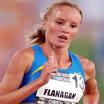
Patrick: As far as disappointments, I don't think there is any unform explanation. Ther more I see at this level-- this was my fifth summer Games-- the more I realize that chance and bad luck can override careful planning. Several US athletes who went to the training camp in Dalian wound up getting Shalene Flanagan, Bronze medalist 10,000 meterssick. Flanagan (bronze medal winner in 10k) wasn't even sure she'd be able to enter the 10k because of gastro-intestinal problems. I think her performance , a U.S. record in those conditions, has been overlooked. I think she was wiped out for the 5k later. If she's 100%, I think she would have been more in the mix for that race.

Dick shared some other observations on the Olympics:
--Allyson Felix wasn't the athlete she's been the last couple of years. I wonder if excess travel might have hurt her. After the trials, she made two round-trips to Europe before going to Beijing. She ran a couple of races on the circuit and returned for a friend's wedding. Then she went back and had a couple sub-par races. She probably should have bagged the second trip.
--Not sure what happened to Sanya Richards. She says her right ham cramped with about 80 to go. Michael Johnson discounts that and says she ran too tight and too hard the first 200 and then paid the price coming home.
--Tyson Gay had bad luck. He just didn't have enough time after the Trials to heal the hamstring. Not that it would have made a difference in the winner -- Bolt is just too good. (I hope he's clean.). Walter Dix had a good meet. He had a hamstring injury in April and was fourth in the NCAA 100. Then he manages two bronzes. I think that Trials/Olympics double is tough for our sprinters. Bolt didn't have eight Trials rounds in his legs before China.
--Another ill-timed injury was Adam Nelson pulling an intercostal muscle a few days before the shot. You make a point that might apply to those guys. The competition to make the U.S. team is so tough that it's tough to peak again a few weeks later for the Olympics. None of the three U.S. guys performed well.
--Jeremy Wariner's race was a disappointment. I still think he made a mistake in leaving Clyde Hart.
--Bernard Lagat seemed another ill-timed injury victim, though this year he has never seemed as strong as he was last year when he did the 1,500-5,000 double at worlds. After the U.S. trials, he followed his usual plan and went to Germany, his headquarters during the Euro season. But he had left Achilles problems that hampered his training. On top of that he came down with a sore throat/respiratory problems in Beijing.
Last year I felt he had an answer for any type of strategy -- hard from the gun or sit and kick. This year I never sensed he had the strength or speed of last year.
--Lolo Jones. What a heartbreak. Not sure what happened in her race. She may have had the thought "I can win an Olympic gold" that distracted her just enough to hit the ninth hurdle. Or maybe she was running so fast she just didn't have enough time to get that lead leg up.
--Don't know what to say about the 4x100s. We've tried to address some of the problems of the past but it doesn't seem to make any difference. But two dropped sticks on the anchor leg was tough to watch.
With all of these disappointments, there might be some teaching points for your runners. For the most part, those disappointed athletes were extremely classy, particularly Jones, Lagat, Nelson, Gay, Felix and Richards. At their lowest moment and under a lot of pressure, they maintained their poise and sportsmanship. I was impressed.

Thanks Dick for your time and for all the years of great coverage!

Wednesday, August 20, 2008

Ocean City Coach Bill Moreland

Coach Bill Moreland, Ocean City, NJ


Coach Moreland with Ocean City team and Yoga Instructor Teri O'Connor of NJ Beach Yoga


Great coaches are rare in any sport. Because running is both an art and a science, a great running coach may be even harder to find. Win loss records are only the first and most ephemeral consideration.
The best coaches are not simply taskmasters, but they do have some common traits—
  • First, they must be experts on running physiology, yet must also be willing to learn more.
  • They must inspire and be good motivators for runners of varying abilities. They must be good listeners, and effective communicators.
  • They must be disciplined but flexible.
  • Finally, they must set a good example and display the commitment and discipline essential for a runner to reach their goals and potential.
    A coach who has all of these traits and one more-- humility-- is Bill Moreland the track and cross country coach of Ocean City, New Jersey High School. Moreland lives in Ocean City with his wife Debbie. They have been married for 35 years. Bill and Debbie have 3 children (all runners of course!) daughters Colsey (who graduated from and ran for TCNJ), Allie (a senior, running for the Naval Academy) and Bill (who will attend Rowan to study Mechanical Engineering and may run track in the spring).
    The first thing that strikes you about Coach Moreland is his ability to inspire all of his runners from senior Brett Johnson the fastest (4:08) high school miler in the country, fifth fastest in New Jersey history, to the novices with no running experience that join the Ocean City team each year and quickly become hooked on the sport. Coach Moreland makes running fun. He is also an outstanding runner who leads by example. We recently caught up with Coach Moreland for his thoughts on a variety of subjects including his personal running streak:
How long have you been running?
I’ve been running seriously for 34 years, I ran sporadically before that.

How did you start your running career?
I started running to get back into shape. I had put on a few pounds after getting married (went from 150 to 160 pounds).

Where did you go to high school, college?
I went to Abington High School in Abington PA, Elizabethtown College in PA and grad school at the University of Delaware.

What is your favorite race?
Probably the Fenton Carey Half Marathon in Ocean City.

What is your favorite place to run?
The beach at dawn or a run through the woods.

How long is your running streak—when did it start and how far do you usually run?
It’s over 26 years. I started on January 15, 1982. I average just over 9 miles per day.

Where have you run the most during your streak?
Before we moved back to Ocean City (four years ago) the trails in Upper Township, now on the beach in Ocean City.


Were there any close calls for the streak?
Yes, the closest was when my oldest daughter Colsey was born. I ran about 11 pm.
Some minor injuries have limited the distance to only 2 miles which is the shortest I’ve run.

How many years have you been a teacher?
I’ve taught mathematics for 38 years. The last 18 years I’ve taught AP Calculus and Honors Precalculus.

How long have you been coaching? (boys/girls):
I’ve been coaching for 38 years. For the first 9 years of teaching I coached basketball and the last 29 years cross country, indoor track and outdoor track.

What are some of your coaching accomplishments?
10 Cape Atlantic League Championships in Cross-Country, 2 South Jersey Group III Championships in Cross Country. 1 South Jersey Group III Championships in track and a Girls Distance Medley Relay national championship team.

Who are some of the best runners you’ve coached?
Brett Johnson, John Fennekohl (both were South Jersey runners of the year).
Matt Cowhey, John Richardson (won Penn Relays mile and the only NJ male to win 1600 meters and 800 meters at New Jersey Meet of Champions).
Erik Geisinger, Eugene Watts, Rich Vinnacombe, Dan Lowden (1st male to make all Cape Atlantic conference 4 years), Bruce and Jeff Welch, Brian McDonald.
Brittany Sedberry, Rene Tomlin, Allie Moreland, Erin Walsh (these 4 girls won national championship).

What is your running philosophy:
Run but don’t strain.

What is your coaching philosophy?
I have always felt my teams were healthier if we under trained rather than over trained.
Our seniors get to about 50 miles a week coming into their senior year. Four healthy years in high school will be more productive for them when they reach the next level.

Can you tell us about your race directing, some of the races you put on?
We put on fun runs every Thursday night in the summer in Ocean City. This is the 30th year and there are 5k cross country and 1600m and 3200m track races each week. (Note, the races are free). Also the Firefighters Memorial 5k in Sea Isle City (this will be the 35th year) and the Longport Bridge 5k which is a fund raiser for the Cross Country and Track programs. (Bill Moreland also put on the popular Hot Foot half marathon and 5k races in Upper Township for years).

What are your recommendations for avoiding injury?
Too much fast running leads to break downs. Change surfaces when you can and alternate your running shoes. 08 Shelby

What are some of your other hobbies/interests?
My mustangs (cars). I just got an 08 Shelby.

It has been said the most valuable gift you can give is your time. Coach Bill Moreland has generously given his time and talents back to running. The sport is better for his efforts. All who have ran for and with him, or in one of his races are extremely grateful for his generosity.

Friday, August 15, 2008

Owen Anderson, The Educated Runner

Owen Anderson, Phd.
It's been 16 years since Owen Anderson was named best running journalist by the Road Runners Club of America. During that interval Anderson has traveled to Kenya (5 times in all) to study Kenyan runners, has published 3 books with a fourth in progress and has contributed to a number of publications including Running Research News, Runners World, Running Times and National Geographic Adventure Magazine. Anderson has developed a peerless reputation for discovering the latest scientific research in exercise and physiology, processing it, and writing about it with enough humor and concrete examples to make the findings both useful and enjoyable to interested runners and coaches. In addition, Anderson is a good enough runner to experience first hand what he is writing about. For example, in an article "In the Halls of the Mountain Kings" published in April 1993, Anderson lived and trained with the Kenyan national cross country team in their national camp at St. Marks College near Embu Kenya to research his article. The result was a remarkable article that made the reader feel like they too were resident in the camp during the lung burning sessions. Andersons latest project is a new website dedicated to giving runners "an advanced degree in training, sports nutrition and injury prevention" called "The Educated Runner": http://www.educatedrunner.com/ In addition, Anderson is is also currently coaching other runners and working on a fourth book for Human Kinetics Publishing entitled "The Science of Running". Anderson believes the 700-page, 45-chapter volume will serve as the ultimate reference for runners who are "interested in upgrading their training and performances."

We recently talked to Owen for his thoughts on two of the most popular topics of discussion for cross-country runners-- hills and developing a kick.

Owen, you've always been a big proponent of hill training, can you tell us why?
Anderson:
Hill training is great because it is the most-specific form of running-specific strength training. You're working against gravity with your own body weight as resistance, and you are actually running, making the gains in strength very specific to running. The neuromuscular patterns are not exactly the same as those which prevail during flat-ground running, but they are closer than those associated with most traditional strength-training movements. In addition, hill training raises oxygen-consumption rate and elevates blood lactate significantly during the uphill surges, effects which should lead to higher VO2max and faster lactate-threshold running speed. Hill training has also been connected with enhanced running economy. Combined, the upgrades in economy and VO2max should lead to an upswing in VO2max, one of the best single predictors of running performance.

What do you think is the best way for a runner to improve his or her kick?
Anderson: To improve kicking power, the most-basic thing a runner can do is to improve his/her fitness. I'm not trying to be a wise guy: If your lactate threshold, vVO2max, running economy, and fatigue-resistance have been upgraded properly via high-quality training, you will be able to sustain quality paces for longer periods of time - and you will have more reserve when you want to "turn on the jets" at the end of a race. You can specifically train to kick, too, by carrying out longer, fatiguing, high-quality intervals (600s, 800s, maybe even 1000s) which then have a blistering 200 tacked on at the end. Fundamentally, of course, you improve your kick by upgrading your maximal running speed (your average pace over, say, 100-300 meters, during a maximal effort). This is something that most endurance runners simply don't do. When their race times get faster, it is because they can sustain paces with which they are already familiar over a longer period of time, not because they have raised the "top end" running speed to the sky. To augment max speed, it is necessary to carry out lots of very intense running, to follow a program of running-specific strength training which progresses into explosive strength training with lots of high-speed drills which mimic the mechanics of running, and also to carry out downhill sprinting (which shortens the deceleration phase of contact and gets runners into the acceleration phase of stance more quickly; this elevates stride rate without hurting stride length, a key way to raise max speed).

Written by Jack Heath

Wednesday, August 13, 2008

Erin Donohues Blog from Beijing

Erin Donohue
Erin Donohue writes from Beijing in a Courier Post Blog
*** Update from Erin on her race***
I have an update on my race: the first round on August 19th was CANCELLED, due to lack of entries. Actually, there are 36 girls entered, enough for 3 rounds, but the local organizing committee decided to cut it out anyway. So now, my first race will be August 21st at 7pm China time, 7am EST. There will be 3 heats of 12 runners and the top 4 in each heat and the next 2 fastest times will advance to the final on August 23rd.

Since leaving Haddonfield, I’ve been busy traveling and settling into the Olympic Village. I arrived in Beijing on the 7th and checked into one of the US Team’s apartments. We’re a big team, so we take up several of the apartment buildings in the Village. I’m staying with five other girls from the track team, including one of my training partners, Shannon Rowbury and my former UNC teammate, Alice Schmidt.

Athletes from all countries live, eat and train in the Village. It’s got a dining hall (featuring a McDonald’s), workout facilities, shopping areas, lounges, and other meeting areas. It’s surreal to see all of these athletes from countries around the world in this place. For instance, I saw Yao Ming, who is fairly easy to spot, casually grabbing a drink in the dining hall.

The day after I arrived, I marched in the Opening Ceremonies. This was a memorable experience, filled with great excitement and lots of sweat. The US Team wore Ralph Lauren Polo suits, which looked sharp, but were a little heavy for the Beijing heat and humidity. Aside from the perfuse sweating, the Opening Ceremonies were amazing. Walking into a stadium of 90,000+ people and watching the torch lighting is something I’ll never forget.

The day after the ceremonies, I left the Olympic Village and flew with some other members of the track team to a training camp in Dalian. Dalian is port city on the Yellow Sea, and the US Track and Field team is staying at a golf course resort hotel north of town. Security around the hotel is tight, and we’re the only group actually allowed in the hotel area. Police block major roads and escort us anytime we leave the hotel. I feel very VIP, but I also feel a little embarrassed that we may be inconveniencing this city of 6 million people every time we need to go somewhere. I know I’d be mad if police shut down Route 70 or 295 because some runners needed to get to a track.

Partially due to this security, the Dalian training camp is much quieter than Beijing, and I’m finding it easier to relax and focus on training here. Since the first round of the women’s 1500m is still over a week away, I can get in a few more quality workouts. Today, I did a tempo run and some drills, and tomorrow, I’ll do a harder interval session on the track. I’m feeling good, and I’ve completely adjusted to the time difference. I’ll let you know how things go here in Dalian and back in Beijing.

Click here to access Erin's Blog Page from the Courier Post: http://www.courierpostonline.com/apps/pbcs.dll/section?category=PluckPersona&U=52c77784ddd746fca661c80a9f6ff6d9&plckPersonaPage=BlogViewPost&plckUserId=52c77784ddd746fca661c80a9f6ff6d9&plckPostId=Blog%3a52c77784ddd746fca661c80a9f6ff6d9Post%3a4abdadbb-f6d1-4794-a559-366b9c0d7bba&plckController=PersonaBlog&plckScript=personaScript&plckElementId=personaDest