Tom Osler
His nickname is "Turtle." But Tom Osler has helped thousands of runners to run faster through the training principles outlined in his three books. Although his

first book was published more than 30 years ago, it remains one of the "absolute classic training books of the world" according to Tim Noakes author of "The Lore of Running." "Tom Osler's great contribution was to emphasize the importance of peaking training. He was the first to verbalize that in a way that was really understandable to most athletes. Most importantly, he was absolutely correct in what he proposed. Our own research undertaken [in South Africa] in the past year shows his principles to be absolutely correct. The principles he described withstood the test of time and are unquestionably real physiological laws."
Although he has never coached, Osler made his contribution by applying his mathematically precise mind to analyze his own training (over 88,000 miles) and racing (upwards of 1,540 races), to answer running's basic questions: How

much, how fast, how often? Osler wove the answers in his own homespun style of writing that is effective in its simplicity. His second book sold over 55,000 copies during the peak of the running boom.
The 60-year-old Osler is presently a Mathematics professor at Rowan University and lives in Glassboro, New Jersey with his wife Kathy. He talked about his running life, his books, and his current views on running. Views arrived at after 47 years of viewing running, through the eyes of a scientist.
RG: Tell us about your first book: "The Conditioning of

Distance Runners."
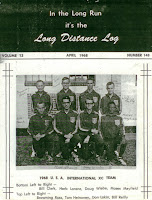
Osler: It was written in the summer of 1967. We printed 2,000 copies at fellow runner George Braceland's printing press. At ten cents a copy, we had 2,000 copies printed for $200. At this time there was really very little running literature. In a library you could find maybe five running books, and some of them might be 35 years old! We advertised them in the Long Distance Log,
which was the only running magazine at the time, for $1.
RG: How many copies were sold?
Osler: I'm not sure. I never copyrighted it. It was public domain and reprinted many times. I was worried about being considered a professional by the AAU, so as soon as 200 were sold, and the cost of production was met, I quickly dropped them off at the late Browning Ross's house to sell the rest. The Long Distance Log had a debt of $500 that was erased, and Browning doubled the size of the Log
through the proceeds of the book.
RG: The late Browning Ross was banned by the AAU for selling shoes. He then entered races under the name L.D. Log. Were you afraid of similar treatment?
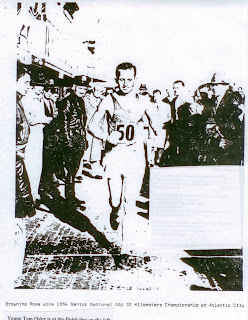
Osler: Yes, running races was a very big part of my life. Incidentally, Ross was able to pay off the debt of the Log through the sales of "Conditioning." He featured me on the cover of the first expanded Log after I won the National 50K championship.
RG: Tim Noakes, author of "The Lore of Running," said the latest scientific testing in South Africa bears out the training principles of "Conditioning." What are these principles?
Osler: Easy, steady running for long periods of time year 'round. This should be comfortable -- but is not jogging. Then, faster, harder training; half-mile repeats, for example, six weeks before your championship race. If done right this peak should last about four weeks. If you dig too deeply into your reserves, you will have a much shorter peak, and run yourself into a slump.
RG: Anything you would change from the first book?
Osler: Yes, I recommended training on the roads. Now I'd recommend running on soft, natural surfaces like grass or trails. Also, I gave seven minutes as the base-building pace. It could really be any pace that resembles the runner's full stride used in racing. This pace is not a jog. Today,

for me, it is slower than eight minutes a mile. But the principle is the same. I've found this type of training to have about an 80% rate of success.
RG: How did you arrive at these principles?
Osler: I grow up in Camden, New Jersey in the 1950s. At that time the conventions were very strong. You only ran in a proper athletic setting. You ran in a park or on a track. You certainly never ran on the streets. If you did, you were stared at by everyone and would probably be stopped for questioning by the police. I followed the conventional training of the day: intervals on the track, no easy training, making every mile count. Unfortunately, I never knew how I would do. My performances were very erratic. After about ten years of this type of training I realized I would never be a great runner because I didn't have great talent. My best mile was only 4:54. I had to do everything right. I decided at this time to just train the way I liked.
RG: An epiphany?
Osler: Yes, I started doing the steady mileage that I enjoy, often reaching 70-75 miles a week. Much of it on the roads. At this time I started to race significantly better. Runners noticed my improvement and would ask me what I was doing

different.
RG: Did they believe you when you told them?
Osler: The amazing thing about runners: you can tell them the one great running secret, but they won't do it themselves. They will keep doing the same thing they've always done. What you are saying is true but it doesn't apply to me. At this time I read Arthur Lydiard's "Run to the Top." It had a big effect on me. Except for the hill-bounding phase, which didn't agree with me, it fit in nicely with what I was doing. It was the final piece of the puzzle.
RG: Describe the sharpening phase.
Osler: Sharpening teaches one to run relaxed even at race pace. I would run repeats that were approximately a half mile as relaxed as possible. This period of training is very taxing and can only be used for a short period of time. Your body will thirst to accelerate during this period. After the sharpening phase, you will run about 10-20 seconds faster per mile.
RG: Are the signs of overtraining the same?
Osler: Yes, if you are even a little bit overtrained you are past the point where you can run your best. Difficulty falling asleep, heavy legs, poor coordination, an 'I don't care' attitude, increased susceptibility to colds and infections, and one other I've learned after 44 years of running: pain in your weak spots. For me my left Achilles starts to hurt when I start to overtrain. The only thing to do at this point is to rest, or resume easier running. God heals and the doctor sends the bills.
RG: What do you think is the most common training mistake?
Osler: It is easy to ignore the early, mild signs of overtraining and train hard after a bad race. This can push the runner into a slumping spiral, and even cause an injury.
RG: Browning Ross called your second book, "The Serious Runners Handbook," the greatest running book. Could you explain your marathon racing strategy from the book?
Osler: Divide the race into thirds. The first third, ignore the other runners. You should feel like you are sitting in a chair. Let your legs do what they want for the first eight or nine miles. The second third of the race, insert little bursts of speed. Run about two of these per mile; maybe catching groups of runners. The last third of the race, take the reins off. The race really starts at 20 miles and you want to have a lot left. All the speed in the world won't help you when you can't run another step.
 RG:
Jeff Galloway credits you with first conceptualizing the idea of walking breaks while running long distances. Explain how this came about.
Osler: I decided to try it while running a 100-mile on the track for a Christmas charity at the college. I ran seven laps and walked a lap. I made it to 85 miles comfortably. This works for marathon training as well. The trick is to start the walking breaks while you are fresh. I can take any runner and have them run twice as far as they've run if they listen to me.
RG: Your third book "Ultramarathoning" with Ed Dodd dealt

with this sort of thing.
Osler: Yes, I wondered how the runners at the turn of the century covered such enormous distances. I did a lot of research and discovered they also did a lot of walking. This type of racing died out. For a while the only ultramarathons you saw were in Britain and they were only staged when they had someone capable of breaking the world record. They would attempt to run the whole distance. With walking breaks, ultras are a piece of cake for any trained runner.
RG: How come American runners are not competitive on the world scene?
Osler: Unfortunately, America does not have a large portion of the population with the body type suited to excel at distance races. Kenya, Morocco, Ethiopia,

Mexico; these countries have large numbers of people who are naturally very thin and do not have to diet. After all, you are fighting gravity when you are trying to run very fast.
RG: So it's not lack of coaching?
Osler: No. There only a few good coaches in the world. Coaches are mostly drill masters. There are only a couple of original thinkers out there. Lydiard was charismatic and a scientist. I was also very impressed with Bill Bowerman when I met him. Very sane and practical. Both knew not to hurt their runners. There have been a lot of so-called great coaches who just had talented runners. Talented runners will succeed. Then the coaches are asked what they did.
RG: It's backwards?
Osler: Yes.
RG: Can you give us an example of when you could have used a coach?
Osler: I entered the Atlantic City 16-mile relay in 1968, intending to run only
the first four-mile leg. I intended to stop after the first leg. I thought it would be a good workout as many of the colleges entered a team in the race. I felt great after the first four-mile leg and was leading the race, so I decided to continue. After the second leg, I still felt great and was still in the lead so I continued. This lasted until about 14 miles when I ran out of gas. I was passed by most of the other teams and ran myself right into a slump. A good coach would have made me stop after the first leg.
RG: You mentioned college runners. Many race directors say the 20-29 year age group is the smallest and least competitive age group. Where are these runners?
Osler: The 40- and 50-year age groups are the biggest participants in races. The 20 year olds will wait until they are in their 30s or 40s and start running for health. The 5K has become the bread and butter of the race calendar. It is more accessible to these runners than the longer races.
RG: Any plans to republish your books or write another?
Osler: I would be glad to republish the books if someone were interested. I would like to write a book looking back on 50 years of racing; the experiences and lessons learned.
RG: You've always considered yourself a racer.
Osler: Yes, I have the head of an elite racer on a non-runner's body. If God gave me the opportunity to relieve 10 moments of my life, many of those would be races. I enjoy that moment in the race when you must use willpower to overrule the body. There is always the spot in the race where the runner is tired and vulnerable to discouragement. I am most proud of those moments when I was able to beat a superior runner by using my head. That is what you remember.
RG: Finally, the best thing about running?
Osler: Running offers both pleasure and pain. There is nothing like the purification of the soul through running. Running helps you connect with what is important in your soul.
[Editor's Note: Our comment on Osler's last answer: Amen to that!]
Running Photos courtesy of Bill Kile and Ed Dodd. Article originally appeared in
 as preparation. For many New Jersey runners this would be the New Jersey State Cross Country Championships held in hilly Holmdel New Jersey in November. The question is what should you do to peak for your most important race that will maximize your chances for success? Some coaches advocate packing in some hard last minute training. Others a reduction in volume, still others rest.
 important races earlier in the season. Did they just have a bad day or is there something they could have done differently to peak properly for their race? To get an insight, here are some thoughts on peaking from some top coaches and athletes:

 couple weeks; what you have to benefit from is a better frame of mind, not harder training. To not run in the Olympics as well as you ran in the trials is a sign of poor final preparation, and I always try to have my runners look back at what they did leading up to a particularly satisfying performance, and consider that approach again. We are not doing so well in preparation these days and it's hard to say where things need to be changed.
 My personal philosophy is peaking is more between the ears than
 anything...except swimming where they shave and go crazy!
 program, some peak and some don’t depending on how they react to VO2 work. I start our peak at 3 weeks out from our Nationals, I drop one workout, hills, give an extra days rest between workouts, and drop the volume slightly. For example, our pre-peak week at Cal State looks like this:
 tend to do well on a great reduction in volume but a week that "mimics" a heavy training week....meaning a mini tempo, a mini speed session and 4-5 miles each day in between.


